
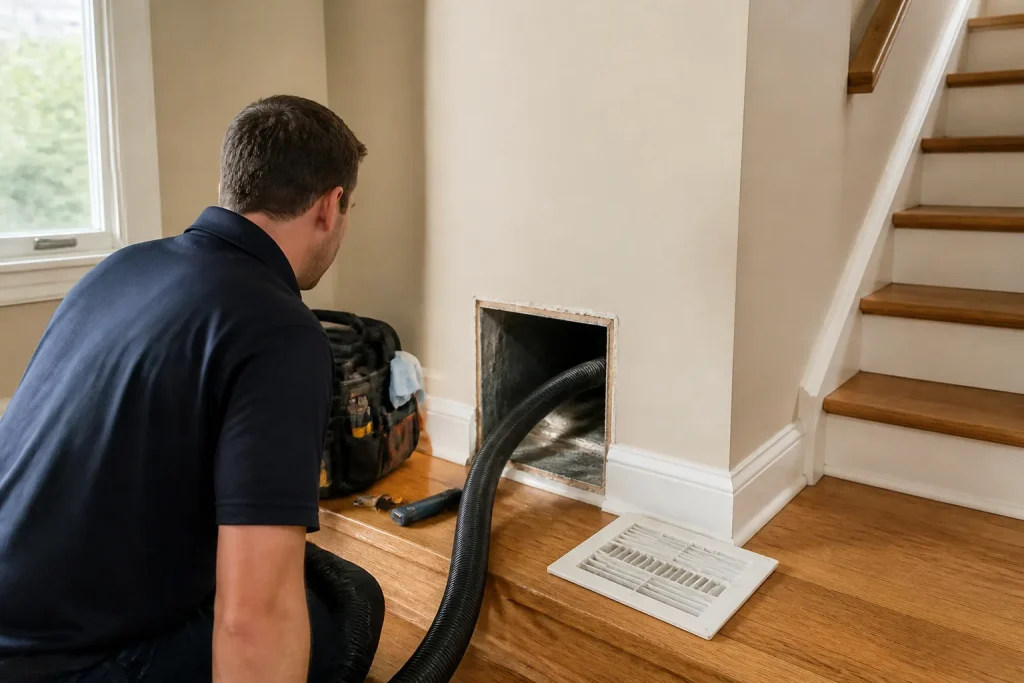
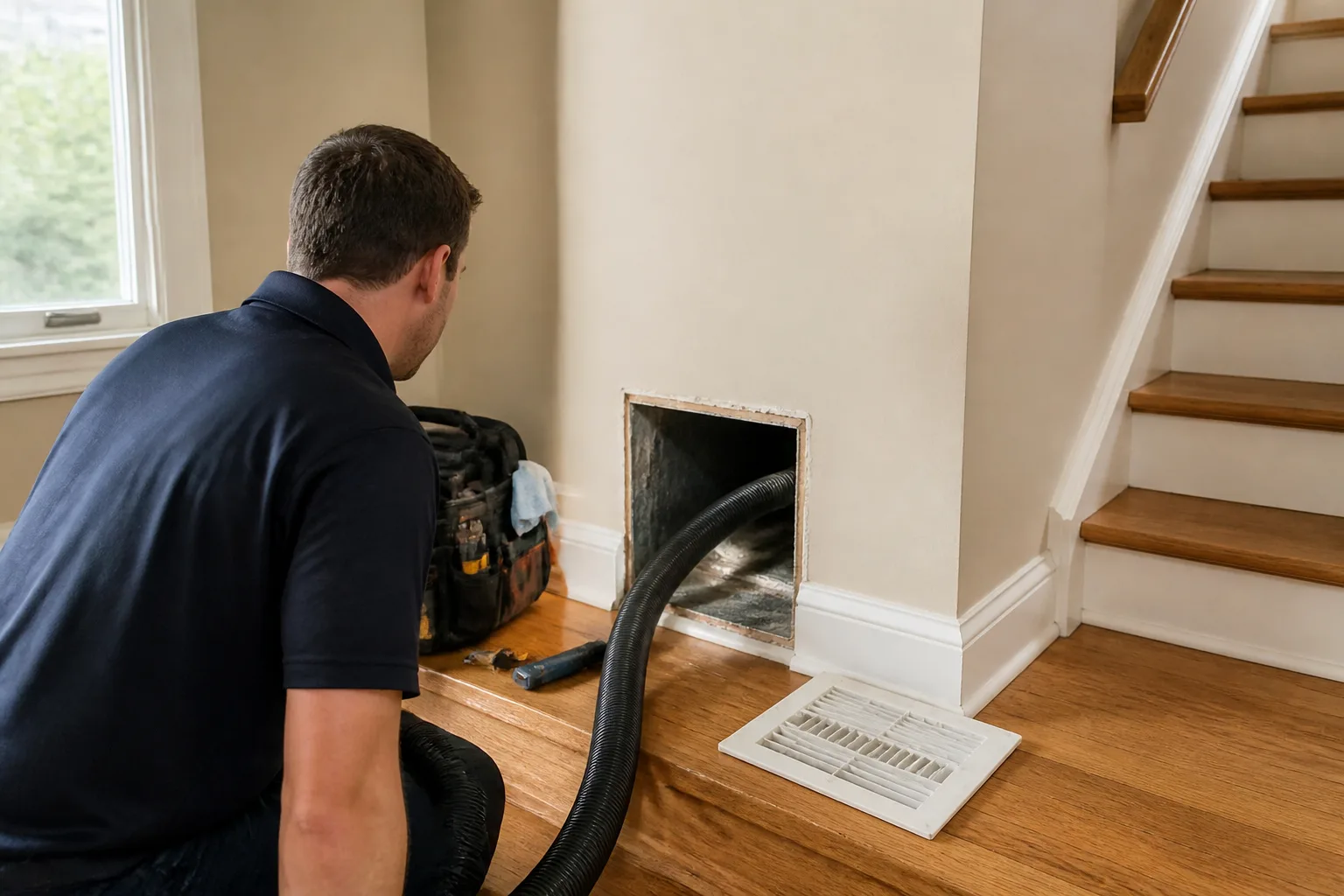
Air Duct Cleaning: Repair or Replace? How Fordham Homeowners Decide
Most Fordham homeowners assume a duct cleaning appointment is about dirt. It usually turns into a diagnosis as well, and that’s where the confusion starts. Cleaning a duct system that’s leaking badly is like washing a car with a cracked windshield and calling it maintenance: the surface looks better, the problem hasn’t moved. Here’s the framework we use to decide whether a system needs cleaning alone, cleaning plus sealing, or replacement. If you’d rather not work through it yourself, call (833) 901-6929 for a free estimate.
What’s the difference between cleaning, sealing, and replacing ducts?
Cleaning removes accumulated debris from inside the ductwork. Sealing closes the gaps, disconnected joints, and breaches that let conditioned air escape into walls, attics, and crawl spaces. Replacing means removing duct sections that are physically failing and installing new ones. These are three different jobs with three different price structures, and a duct system can need any combination of them.
In Fordham, the housing stock decides a lot of this before anyone picks up a tool. Ductwork installed between the 1960s and 1980s is common here, and that era of installation shows predictable patterns: flex runs that have sagged or collapsed under their own weight, joints that were taped rather than mechanically fastened, and duct liner that has started to break down and shed fibers into the airstream. A cleaning that ignores those conditions has a short shelf life. Debris comes back faster through a leaking system, and the leaks keep pushing conditioned air into places it was never meant to go.
The practical point for Fordham homeowners is this: a cleaning visit is the only time anyone gets a clear look inside the whole duct pathway. Treat it as an inspection with cleaning attached, not the other way around.
How much air loss tips the scale from cleaning to sealing?
As a rough working threshold, when a duct system is losing roughly 20 to 30 percent or more of its conditioned air through leaks, sealing delivers a better return than cleaning alone. Below that range, cleaning on its own usually holds up. Above roughly 40 percent leakage, the system isn’t just dirty, it’s functionally broken, and cleaning without sealing is money spent on the wrong problem.
Those percentages come from testing, not eyeballing. A technician can measure airflow at the registers or use a duct leakage test to estimate how much air the system is losing between the air handler and the rooms it’s supposed to serve. What the numbers don’t capture is location. A small leak in a crawl space that dumps conditioned air outdoors matters more than a larger leak inside the conditioned envelope. We factor location into the recommendation alongside raw leakage percentage.
For Fordham homes, the signs that leakage is worth measuring closely tend to stack up:
- Rooms at the end of long duct runs that never quite heat or cool like the rest of the house
- Dust settling on surfaces faster than it used to, especially near supply registers
- Higher energy use without a change in habits or occupancy
- Whistling or rushing sounds at registers when the system runs
- Visible dust streaks around duct joints or ceiling penetrations
If two or more of those are familiar, ask for leakage testing during the cleaning visit rather than after.
What physical damage shows up during a duct cleaning?
Some duct problems only become visible once the system is opened up, and they change the plan on the spot. The three most common in Fordham homes are collapsed flexible duct sections, disconnected joints hidden above ceilings or in crawl spaces, and deteriorating internal duct liner.
Collapsed flex duct is the easiest to understand: the inner liner pinches shut, airflow drops, and no amount of cleaning restores capacity because the airway itself is restricted. Disconnected joints are worse than they sound. A joint that has separated behind drywall pulls attic or crawl space air into the supply side of the system, which means the house is drawing in whatever happens to be in that cavity. Deteriorating liner is a material failure; once the lining starts to break down, cleaning can make it worse by disturbing fibers that were barely holding together.
In our experience, a homeowner who gets a post-service report listing one of these findings usually wants to know whether repair is urgent. It is not always an emergency, but it is almost always worth fixing before the next cleaning. Cleaning, sealing, and repair handled together is less disruptive than three separate visits, and that’s why we offer duct repair and sealing alongside cleaning rather than sending it to another contractor.
None of this is work to attempt with tape from a hardware store. Duct systems sit behind drywall, above ceilings, and inside cavities where a wrong move can damage the system or create a hazard. A trained technician is the right call for both the inspection and the repair.
How does duct age and material affect the repair-or-replace call in Fordham?
Material type and installation quality, more than age alone, drive the repair-or-replace decision in Fordham. Ductboard from the 1970s and 1980s that has absorbed moisture or lost its inner lining usually can’t be repaired in place. Older flex duct can often be re-supported and sealed if the inner liner is intact. Sheet metal from the same era is frequently the most repairable of the lot, provided the seams and joints can be reached.
Original installation quality matters just as much. A system that was properly supported, mechanically fastened, and sealed at installation holds up far better than one that was taped together and run through unconditioned space without a plan. When we look at Fordham ductwork, we’re assessing:
- Whether the inner liner of flex runs is intact and the run isn’t pinched or sagging
- Whether ductboard has been exposed to moisture or shows a failing liner
- Whether sheet metal joints can be reached and mechanically sealed
- Whether the duct layout itself is causing the comfort problems, not just the leaks
When two or more of those come back negative, replacement of the affected runs is usually the more honest recommendation than repeated repair. Most homes land somewhere in the middle: a few runs to replace, most of the system to clean and seal.
Aeroseal or manual sealing: how is the method chosen?
Aeroseal is a sealing method that injects a fine aerosol sealant into the duct system and lets it settle into leaks as the air escapes. Manual mastic sealing is the traditional approach: a technician physically reaches each joint and applies mastic or approved tape. The method choice comes down to leak size, leak location, and access.
Aeroseal is a good fit for many small leaks distributed across a lot of ductwork, especially when the ducts run through wall cavities and ceilings where nobody can reach a joint by hand. Manual sealing is the better choice for larger gaps and for joints that are accessible, because a technician can build the repair with material that holds up over time and confirm it was done correctly. Many Fordham jobs end up using both: manual sealing on what’s reachable, aerosol sealing for the rest.
What we don’t recommend is choosing a method before the system has been inspected. The method follows the findings, not the other way around. Equipment-wise, the job is done with purpose-built machinery, not improvised tools. We use Rotobrush and Nikro systems for cleaning, with Guardsman and Honeywell components where the duct system calls for them, and we confirm compatibility with the existing HVAC equipment before anything is applied.
If you want the full service line in one place, our Air Duct Cleaning Fordham page covers what a visit includes from start to finish.
How do you read a post-inspection report?
A post-inspection report should tell you three things: what was found, what it means, and what the recommended next step is. If it only says “recommend cleaning,” ask for specifics. Here’s the shorthand we use to explain reports to Fordham homeowners.
- Clean and done: Debris volume is high, leakage is low, materials are intact, and joints are sealed. No repair needed. Schedule the next cleaning based on conditions, not a calendar.
- Clean and seal: Leakage is above the useful threshold, joints are disconnected or tape has failed, but materials are still serviceable. Clean, then seal. This is the most common outcome in Fordham homes with 1970s and 1980s ductwork.
- Replacement overdue: Collapsed flex, failing duct liner, or ductboard that has been wet. Cleaning and sealing won’t hold. Repair the affected runs before the cleaning, or the cleaning is wasted money.
The report should also note anything the technician couldn’t access, because “not inspected” is not the same as “in good shape.” Ask about it.
When to call a pro: any time the system shows disconnected joints, musty odors that return after cleaning, or visible damage to duct materials. A trained technician can inspect, seal, and repair the system in one visit. Our air duct cleaning service covers the full pathway, and if the inspection turns up leaks, we seal them on the same visit rather than booking a second appointment.
Related services in Fordham: if the system also includes a dryer vent that hasn’t been serviced, dryer vent cleaning is worth booking alongside the duct work. If the air handler itself has accumulated debris, HVAC cleaning addresses the unit that moves the air through the ducts.
The Bottom Line
Cleaning, sealing, and replacing are three different decisions, and the right one depends on how much the system is leaking, what condition the materials are in, and how the ductwork was put together in the first place. Cleaning alone is the right call for a dirty but sound system. Clean and seal is the right call for leakage above roughly 20 to 30 percent with serviceable materials. Replacement of the affected runs is the right call when flex has collapsed or liner has failed. A post-inspection report should tell you which one applies, in plain language, before you commit to work.
If you’re in Fordham and want a straight answer about which path your ducts need, Air Duct Cleaning Fordham offers free estimates. Call (833) 901-6929. We answer 24/7. Fast dispatch from 7am to 7pm, Sunday through Friday. Every job is quoted one flat price per system before work starts, with before-and-after photos of your own ducts so you can see what changed. The local pro performing the work is licensed and insured as their state requires, and estimates are always free.
Frequently Asked Questions
Air duct cleaning in Fordham is priced per system by written estimate, not per vent, because a small house with a simple layout costs far less than a larger home with multiple zones. Cleaning, sealing, and repair are each quoted separately so you can see exactly what you’re paying for. The written estimate sets the final price. Call (833) 901-6929 for an exact quote, estimates are free.
Low quoted prices usually leave out something important: the parts of the system that are hard to reach, the sealing work, or the equipment quality. A shop vacuum and a brush don’t clean the full duct pathway the way a Rotobrush or Nikro system does. The cheapest quote also tends to be the one that becomes a larger bill once the technician is on site. We give one flat price per system before work begins, so the number doesn’t move. Call (833) 901-6929 to schedule a free estimate.
Ask for before-and-after photos of your own ducts, not stock photos. Ask for the post-inspection report listing what was found, what was cleaned, and whether any repair or sealing was recommended. If the report is vague, ask for specifics. Call (833) 901-6929 if you’d like a walkthrough of what our reports include.
For most Fordham homes, every few years is a reasonable starting point, but the honest answer is that it depends on the house: pets, recent renovation dust, moisture problems, and how well the system is sealed all change the interval. A system that’s been sealed properly holds its cleanliness longer than one that leaks. Call (833) 901-6929 for a free estimate and a straight answer about your system.
Written by the team at Air Duct Cleaning Fordham.
Need Air Duct Cleaning Help?
Call Air Duct Cleaning Fordham - the local pro we connect you with is licensed and insured, with free written estimates in Fordham.
(833) 901-6929